Genome-wide association studies
(GWAS) are a method of identifying genetic variants statistically associated with
a biological trait of interest. Before we can understand what that means, at
least for those of you who are beginners when it comes to genetics, we need to
learn what is meant by genetic variants and what is meant by traits.

A common metaphor to understand the
human genome is to think of it as an instruction manual on how to build and
maintain YOU written in the language of DNA. The DNA alphabet is only 4 letters long consisting of the nucleotides adenine, cytosine, guanine and thymine denoted as A, C, G and T respectively.

The letters in this alphabet are used to compose three letter words called codons which code for their corresponding amino acids as well as codons which signal the start and end of a sequence to be translated.
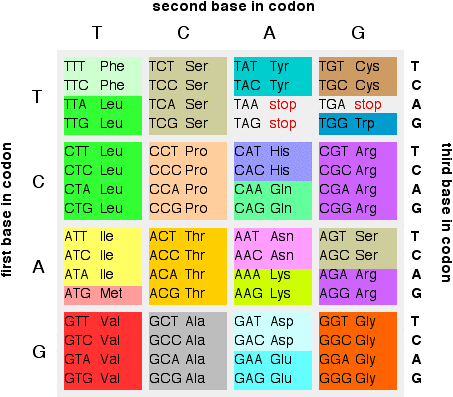
In the same way that a chain of words form a sentence a chain of amino acids form a protein. A gene can be thought of as a paragraph containing these sentences which tell your cells how to make the proteins which form the building blocks of your body. Genes consist of exons, the sequences which are translated into amino acids, and introns, non-coding sequences of DNA which can be thought of as the punctuation between sentences.

The letters in this alphabet are used to compose three letter words called codons which code for their corresponding amino acids as well as codons which signal the start and end of a sequence to be translated.
In the same way that a chain of words form a sentence a chain of amino acids form a protein. A gene can be thought of as a paragraph containing these sentences which tell your cells how to make the proteins which form the building blocks of your body. Genes consist of exons, the sequences which are translated into amino acids, and introns, non-coding sequences of DNA which can be thought of as the punctuation between sentences.

Paragraphs are divided amongst chapters of the genome called chromosomes. Within each chapter paragraphs are separated by pages
and pages of non-coding DNA, vastly outnumbering the amount of space taken up by the paragraphs. Within these pages are found sequences called transcription factors which contain information such as under which conditions and how frequently the instructions in the
paragraphs should be carried out. The instruction manual contains 23 chapters and is 3.3 billion letters long.

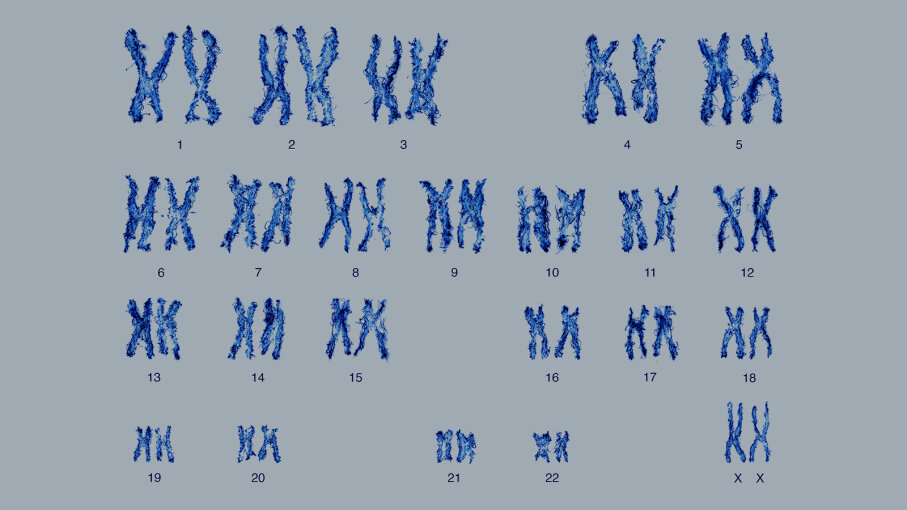
Your genome is more than 99 percent identical to the genome of any other human. The less than one percent difference in our genomes are genetic variants. Often these are one letter changes in different positions across your genome called Single Nucleotide Polymorphisms or SNPs. A "C" in one part of a page where others have a "T" might result in a differently shaped protein or a change in the conditions under which the protein is produced or the frequency which it is produced at.


More often than not however the one
letter changes will either be on a part of a page which makes no difference to the
instructions or the changes they make will not result in a biological difference.
The few SNPs which do make a difference are responsible for the biologically
inherited diversity we can observe between individuals including factors which
influence the way we behave. This observable diversity in biological features
is what we mean when we are talking about traits.
A trait can be either quantitative
or qualitative. A quantitative trait is one which differs in the level which it
is expressed. Height would be an example of quantitative trait because people
differ on a spectrum from short to tall. A qualitative trait is one which takes
one of a number of distinct forms such as eye colour which can be one of a few
different colours e.g. blue, brown or green.


To use a behavioural example, how
highly someone scores on a measure of extroversion from a personality test
would be a quantitative trait whereas whether or not someone has ever went
sky-diving would be a qualitative trait.
GWAS, therefore, is way of
answering the question "what are the biological consequences of single
letter variations in our instruction manuals" by finding out what genetic
variants are associated with different traits.
GWAS are carried out by taking a
measure of a trait from a large sample of individuals alongside nucleotides
from a series of carefully chosen positions within the genome and performing
statistical analyses to identify associations between genetic variants and the
trait of interest. Essentially, the goal in carrying out GWAS is to find
genetic variants which are more likely to be found in those possessing a qualitative trait,
or those who express a quantitative trait to a greater extent, than would be expected
from the population as a whole.
So if individuals who have the aforementioned C in one part of a page were 0.05% more likely to have gone skydiving than those who have a T some newspaper might claim that scientists have discovered "the skydiving gene".
Revision
Instruction Manual
|
Genome
|
Chapter
|
Chromosome
|
Paragraph
|
Gene
|
Sentence
|
Exon
|
Punctuation
|
Intron
|
Word
|
Codon
|
Language
|
DNA
|
Letter
|
Nucleotide
|

No comments:
Post a Comment